Whether you’re a competitive athlete, a weekend warrior, or simply someone who likes to stay active, injuries have a way of derailing your momentum. The frustrating part is that most injuries aren’t random — they trace back to a specific weak link: a muscle that isn’t firing properly, a joint that won’t move the way it should, or a left-to-right imbalance you can’t feel until it lets you down. At Nobility Chiropractic & Wellness in Smiths Falls, we use applied kinesiology to find those weak links and address them — so you recover faster and stay in the game longer.
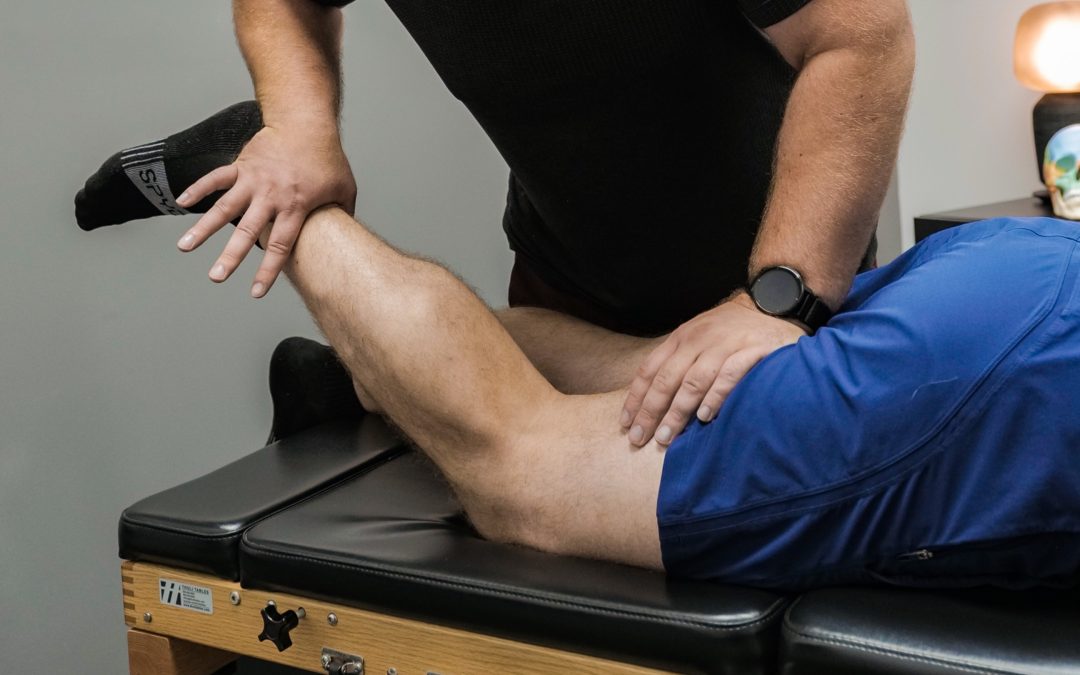
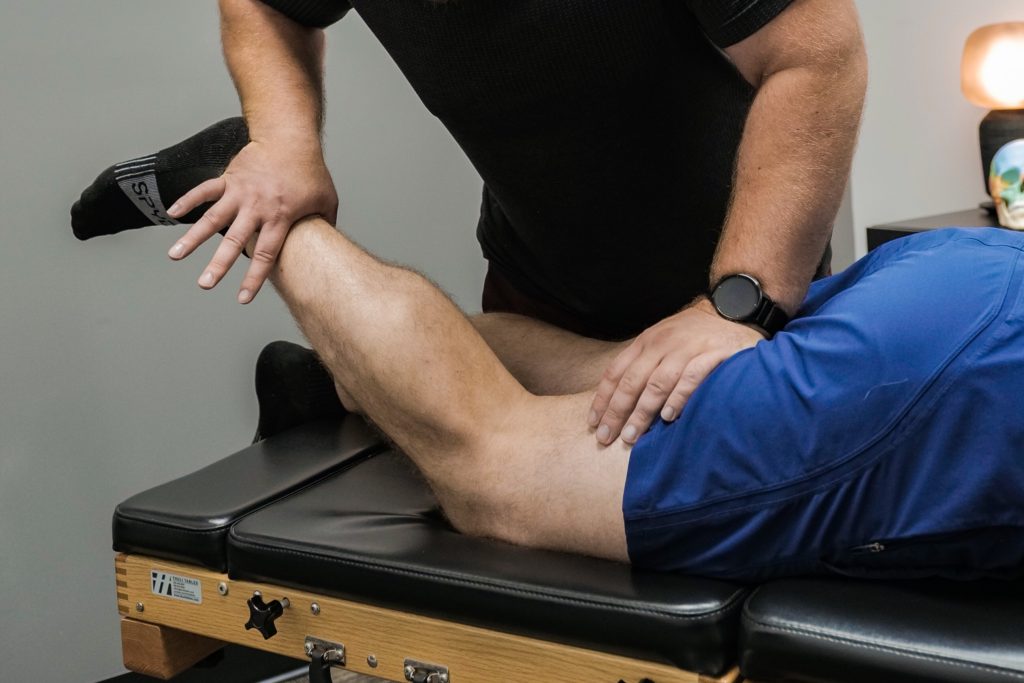
Muscle testing helps pinpoint which muscles aren’t pulling their weight.
What Is Applied Kinesiology?
Applied kinesiology (AK) is a hands-on assessment approach that looks at how your muscles, joints, and nervous system are working together. Rather than treating a sore spot in isolation, we combine manual muscle testing with movement and neurological assessment to map out where your body is compensating — a glute that isn’t switching on, a stiff ankle changing how you land, or a stabiliser that fatigues too early. New to the idea? Start with our primer on what applied kinesiology is and how it helps correct muscle imbalances.
Why Athletes Get Injured — and Where AK Fits In
Athletes ask more of their bodies, and small imbalances add up under load. The research backs this up: left-to-right strength differences and movement asymmetries are consistently linked to a higher risk of injury.1 Put simply, when one side is quietly doing more than its share, it’s often only a matter of time before something gives. Applied kinesiology is built to catch that kind of hidden weak link before it becomes a strain or a tear. For the flip side of the same coin, see the connection between muscle testing and peak athletic performance.
Recover Faster by Treating the Cause, Not Just the Symptom
When you’re already hurt, the fastest route back is fixing what actually caused the problem — not just calming the painful area. By pinpointing the muscles that aren’t pulling their weight and the joints that aren’t moving freely, we can target treatment with adjustments, soft-tissue work, and specific corrective exercises. That means less guesswork and a more direct path back to training. It’s the same root-cause approach we take with common sport injuries like hamstring strains and ACL rehabilitation.
Prevent the Next Injury
The best injury is the one that never happens. Decades of sports-medicine research show that structured, movement-based training can cut injury rates dramatically: a systematic review in the British Journal of Sports Medicine found neuromuscular training reduced injuries in young athletes by roughly a third,2 and programs such as FIFA 11+ have produced similar drops in ankle and lower-limb injuries.3 Applied kinesiology makes that prevention personal — instead of a generic warm-up, we build a corrective plan around your specific weak links. Learn more about how we use it to enhance athletic performance and the broader role of chiropractic in sports performance.
What to Expect at Nobility Chiropractic
Your first visit starts with a thorough assessment — health history, a movement screen, and muscle and joint testing — so we understand how your body is really working. From there, Dr. Bryan Pankow builds a tailored plan that pairs hands-on treatment with targeted exercises, then re-tests to make sure the change sticks. The goal is simple: get you moving well, performing better, and staying healthy.
Book with a Sport-Focused Chiropractor in Smiths Falls
If you’re an athlete in Smiths Falls or Lanark County who’s tired of the same nagging injuries, applied kinesiology can help you find the root cause and build a plan around it. Learn more about applied kinesiology at Nobility, or book an appointment to get started.
Applied Kinesiology (AK) is a biomechanical and neuromuscular assessment framework I’ve trained in for the better part of a decade. Used well, it’s one of the more useful tools I have for figuring out what’s actually going on with an athlete’s body — particularly when conventional assessment hasn’t given clear answers.
The short version: AK uses manual muscle testing to detect inhibition and facilitation patterns — muscles that aren’t firing properly because the nervous system has dialed them down, often in response to old injuries, joint dysfunction, or compensation patterns that have been running for years. Once those patterns are identified, treatment can be targeted at what’s actually driving them rather than at where the pain happens to be felt.
This post explains how I use AK in practice, the underlying neuromuscular concepts the work is built on, and where the evidence sits.
A note before we get into it: this is general information about how I practice, not specific medical advice. Whether AK assessment is useful for your particular situation depends on what you’re dealing with — and that’s a conversation in person, not on the internet.
What “muscle inhibition” actually is
The core concept under AK is that muscles can be neurologically inhibited — not weak from lack of training, not torn or injured, but turned down by the nervous system. The muscle is structurally fine; it’s just not getting the signal to fire properly.
This isn’t a fringe idea. It’s a well-established concept in sports medicine and physiotherapy — particularly under the term arthrogenic muscle inhibition (AMI). The classic example is what happens to the quadriceps after an ACL injury: the muscle is intact, but neural signals from the swollen, painful joint suppress activation. Athletes can lose 30-50% of their quad strength even when the muscle itself is uninjured.[1]
A 2018 scoping review in the British Journal of Sports Medicine identified arthrogenic muscle inhibition as a critical factor limiting recovery after ACL reconstruction, and reviewed evidence-based interventions for addressing it.[2] This is mainstream sports medicine, published in one of the most-cited sports medicine journals in the world.
The same neurological mechanisms — joint inflammation, faulty proprioceptive input, altered reflex patterns, central nervous system adaptation — produce inhibition in less dramatic situations all the time. Old ankle sprains affect glute activation. Chronic low back pain alters core firing patterns. A history of shoulder impingement can dial down rotator cuff recruitment for years after the original injury healed.
None of that shows up on an MRI. None of it shows up on a strength test where you ask someone to push with maximum effort against a hand dynamometer. But it shows up on assessment when you know what you’re looking for — and it directly affects how an athlete moves, performs, and gets injured.
How I use AK in practice
What an AK assessment session actually looks like at the clinic:
1. History and movement screen. Same as any assessment — current complaints, training history, prior injuries, what you’re trying to accomplish.
2. Muscle testing as part of the physical exam. I assess the strength and recruitment quality of muscles relevant to your complaint and your sport. The test is: can this muscle hold against a controlled force in a specific position, with the right timing and quality of activation? I’m not looking for raw strength — I’m looking for inhibition, asymmetry, and recruitment patterns that don’t match what your body should be capable of.
3. Identifying drivers. When I find a muscle that’s inhibited, the next question is “why?” Sometimes the answer is local — a joint restriction, a fascial adhesion, a trigger point in a synergist or antagonist muscle. Sometimes the answer is upstream or downstream — a hip problem creating compensatory patterns at the knee, a thoracic restriction altering shoulder mechanics. AK gives me a real-time framework for testing these hypotheses rather than guessing.
4. Treatment with retest. If I think a joint restriction is driving an inhibition pattern, I’ll address it and retest. If the muscle now activates properly, that’s confirmation. If it doesn’t, I look elsewhere. The test-retest cycle is what separates AK from “I think I know what’s wrong, let me try this and hope for the best.”
5. Homework matched to findings. The exercises and self-care I recommend are based on what the assessment actually showed, not on a generic protocol for your complaint.
What the literature supports — and where it’s mixed
Worth being honest about the evidence picture:
The mechanism of muscle inhibition is well-established. AMI is a real, measurable, neurologically-mediated phenomenon. The literature is clear that joint pathology, inflammation, and altered afferent input can produce profound inhibition of surrounding musculature, and that interventions aimed at restoring normal joint function and afferent input can help reverse it.[1][2]
Spinal manipulation produces measurable changes in muscle activation. A 2018 RCT in elite athletes showed significant increases in maximum voluntary contraction and corticospinal excitability after a single manipulation, persisting 30-60 minutes.[3] A separate study found 44-54% increases in motor evoked potentials following manipulation, suggesting changes happen at the level of cortical drive — exactly the kind of effect AK practitioners describe clinically.[4] When AK assessment leads me to deliver an adjustment and I see immediate facilitation of a previously inhibited muscle, the underlying neuromechanism is supported.
Manual muscle testing reliability is the honest weak link. A 2020 study examining force profiles of testers performing manual muscle tests found significant differences between experienced and beginner testers, and even experienced testers showed inter-tester variability and partial intra-tester reproducibility issues.[5] Older research on traditional manual muscle testing in clinical populations also showed reproducibility problems compared to instrumented testing.[6]
The honest interpretation: MMT is a tester-skill-dependent tool. Done by someone with significant training and standardization, it produces consistent results. Done by someone untrained or inconsistent in their force application, it doesn’t.
This is part of why I’ve invested 400+ hours of additional training beyond the initial ICAK certification — including multiple 100-hour AK course series, clinical pearls work with the late Dr. Wally Schmitt, and instruction with Dr. David Leaf at ICAK international meetings. The certification covers the basics; proficiency comes from deliberate practice, study with senior practitioners, and consistent recalibration. It’s also why MMT is best used as one component of a comprehensive assessment, not the sole basis for diagnostic conclusions.
Where AK earns its keep
The honest version of where this approach pays off:
Identifying neuromuscular inhibition patterns that don’t show up on standard strength testing or imaging
Real-time test-retest assessment to confirm whether an intervention actually worked
Untangling complex compensation patterns where pain in one location is being driven by dysfunction elsewhere
Building an individualized treatment and homework plan based on what your specific body needs, rather than a protocol
Performance work with athletes whose strength on paper doesn’t match how they actually move and generate force in their sport
For anything outside the musculoskeletal scope — bloodwork, imaging, allergy testing, nutritional analysis, or specialist medical care — the right answer is referral to the appropriate professional. I work within my scope.
Why this approach matters for athletes
Most assessment systems for athletes rely on either subjective complaint (“my hamstring feels tight”) or maximum-effort strength testing (“can you push as hard as possible against this”). Both have value, but both miss the layer where most performance-limiting dysfunction actually lives.
The athletes I see most often aren’t catastrophically injured. They’re partially inhibited. The hamstring that’s “tight” is often actually under-recruited. The shoulder that “feels off” has a serratus anterior that’s not firing properly. The knee that “doesn’t track right” has a glute that’s not doing its job.
You can train through these patterns for a long time before they become an injury — but they cost you in performance, and they raise your injury risk over time. AK gives me a way to find them earlier and address them more precisely.
Common questions
What does an AK assessment add to my visit? It adds a structured, testable framework for figuring out what your specific body needs on the day you come in. Muscle testing gives me real-time information that informs which interventions to use, in what order, and whether they actually worked before you walk out the door. The treatment itself — adjustments, soft tissue work, exercise prescription — is similar to what you’d see in any sport-focused chiropractic visit; the assessment is what makes the plan more individualized.
Do I need to “believe in” AK for it to work? No. AK isn’t a faith-based system in how I practice it. The muscle either tests strong or it doesn’t. The intervention either changes the test or it doesn’t. You can be skeptical of the framework and still benefit from it, the same way you can be skeptical of “core stability training” and still benefit from learning to brace properly.
Is this covered by insurance? The chiropractic care itself is. There’s no separate “AK fee” — assessment is part of how I work, not an add-on service.
How long does an AK-informed visit take? About the same as a regular chiropractic appointment. Initial assessments run longer (45-60 minutes) because of the comprehensive movement and muscle screen. Follow-ups are shorter (15-30 minutes) since we’re working from a known baseline.
Do you do AK on non-athletes? Yes. The framework is just as useful for desk workers with chronic pain, post-surgical patients managing residual deficits, or anyone whose body has compensation patterns from old injuries. It’s not athlete-exclusive — that’s just where the gains are most visible.
What does an AK assessment actually feel like? Mostly like a thorough orthopedic exam. I’ll have you in different positions — supine, prone, standing, sometimes mid-movement — and apply controlled force to various muscles while you resist. It’s not painful, it’s not strenuous, and you don’t need to be at maximum effort. The goal is to feel how your body responds, not how hard you can push.
If you want to try it
I’m an ICAK-certified Applied Kinesiology practitioner with 400+ hours of additional AK training beyond the certification, including study with the late Drs. Wally Schmitt and David Leaf. I see athletes, tactical professionals, and active people across both Nobility Chiropractic & Wellness in Smiths Falls and Nobility Performance in Stittsville.
If you’re an athlete dealing with persistent issues that haven’t responded to conventional approaches, or you want a more individualized assessment than a generic protocol-based visit, this is the work.
Pietrosimone B, Lepley AS, Kuenze C, et al. Arthrogenic Muscle Inhibition Following Anterior Cruciate Ligament Injury. J Sport Rehabil. 2022;31(6):694-706. doi.org/10.1123/jsr.2021-0128
Sonnery-Cottet B, Saithna A, Quelard B, et al. Arthrogenic muscle inhibition after ACL reconstruction: a scoping review of the efficacy of interventions. Br J Sports Med. 2019;53(5):289-298. doi.org/10.1136/bjsports-2017-098401
Christiansen TL, Niazi IK, Holt K, et al. The effects of a single session of spinal manipulation on strength and cortical drive in athletes. Eur J Appl Physiol. 2018;118(4):737-749. doi.org/10.1007/s00421-018-3799-x
Haavik H, Niazi IK, Jochumsen M, et al. Impact of Spinal Manipulation on Cortical Drive to Upper and Lower Limb Muscles. Brain Sci. 2017;7(1):2. doi.org/10.3390/brainsci7010002
Bittmann FN, Dech S, Aehle M, Schaefer LV. Manual Muscle Testing—Force Profiles and Their Reproducibility. Diagnostics (Basel). 2020;10(12):996. doi.org/10.3390/diagnostics10120996
Escolar DM, Henricson EK, Mayhew J, et al. Clinical evaluator reliability for quantitative and manual muscle testing measures of strength in children. Muscle Nerve. 2001;24(6):787-93. doi.org/10.1002/mus.1070