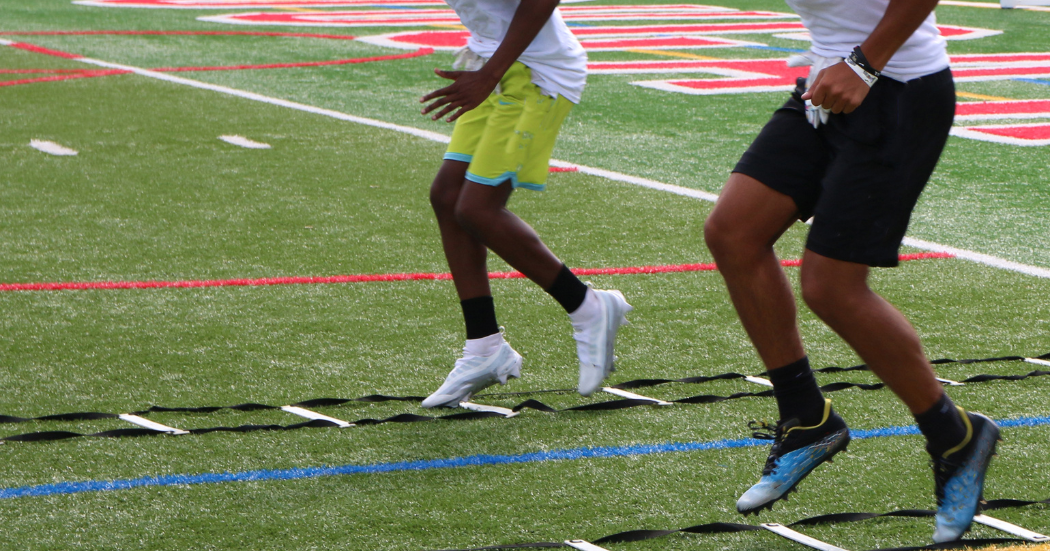
Applied Kinesiology (AK) is a biomechanical and neuromuscular assessment framework I’ve trained in for the better part of a decade. Used well, it’s one of the more useful tools I have for figuring out what’s actually going on with an athlete’s body — particularly when conventional assessment hasn’t given clear answers.
The short version: AK uses manual muscle testing to detect inhibition and facilitation patterns — muscles that aren’t firing properly because the nervous system has dialed them down, often in response to old injuries, joint dysfunction, or compensation patterns that have been running for years. Once those patterns are identified, treatment can be targeted at what’s actually driving them rather than at where the pain happens to be felt.
This post explains how I use AK in practice, the underlying neuromuscular concepts the work is built on, and where the evidence sits.
A note before we get into it: this is general information about how I practice, not specific medical advice. Whether AK assessment is useful for your particular situation depends on what you’re dealing with — and that’s a conversation in person, not on the internet.
What “muscle inhibition” actually is
The core concept under AK is that muscles can be neurologically inhibited — not weak from lack of training, not torn or injured, but turned down by the nervous system. The muscle is structurally fine; it’s just not getting the signal to fire properly.
This isn’t a fringe idea. It’s a well-established concept in sports medicine and physiotherapy — particularly under the term arthrogenic muscle inhibition (AMI). The classic example is what happens to the quadriceps after an ACL injury: the muscle is intact, but neural signals from the swollen, painful joint suppress activation. Athletes can lose 30-50% of their quad strength even when the muscle itself is uninjured.[1]
A 2018 scoping review in the British Journal of Sports Medicine identified arthrogenic muscle inhibition as a critical factor limiting recovery after ACL reconstruction, and reviewed evidence-based interventions for addressing it.[2] This is mainstream sports medicine, published in one of the most-cited sports medicine journals in the world.
The same neurological mechanisms — joint inflammation, faulty proprioceptive input, altered reflex patterns, central nervous system adaptation — produce inhibition in less dramatic situations all the time. Old ankle sprains affect glute activation. Chronic low back pain alters core firing patterns. A history of shoulder impingement can dial down rotator cuff recruitment for years after the original injury healed.
None of that shows up on an MRI. None of it shows up on a strength test where you ask someone to push with maximum effort against a hand dynamometer. But it shows up on assessment when you know what you’re looking for — and it directly affects how an athlete moves, performs, and gets injured.
How I use AK in practice
What an AK assessment session actually looks like at the clinic:
1. History and movement screen. Same as any assessment — current complaints, training history, prior injuries, what you’re trying to accomplish.
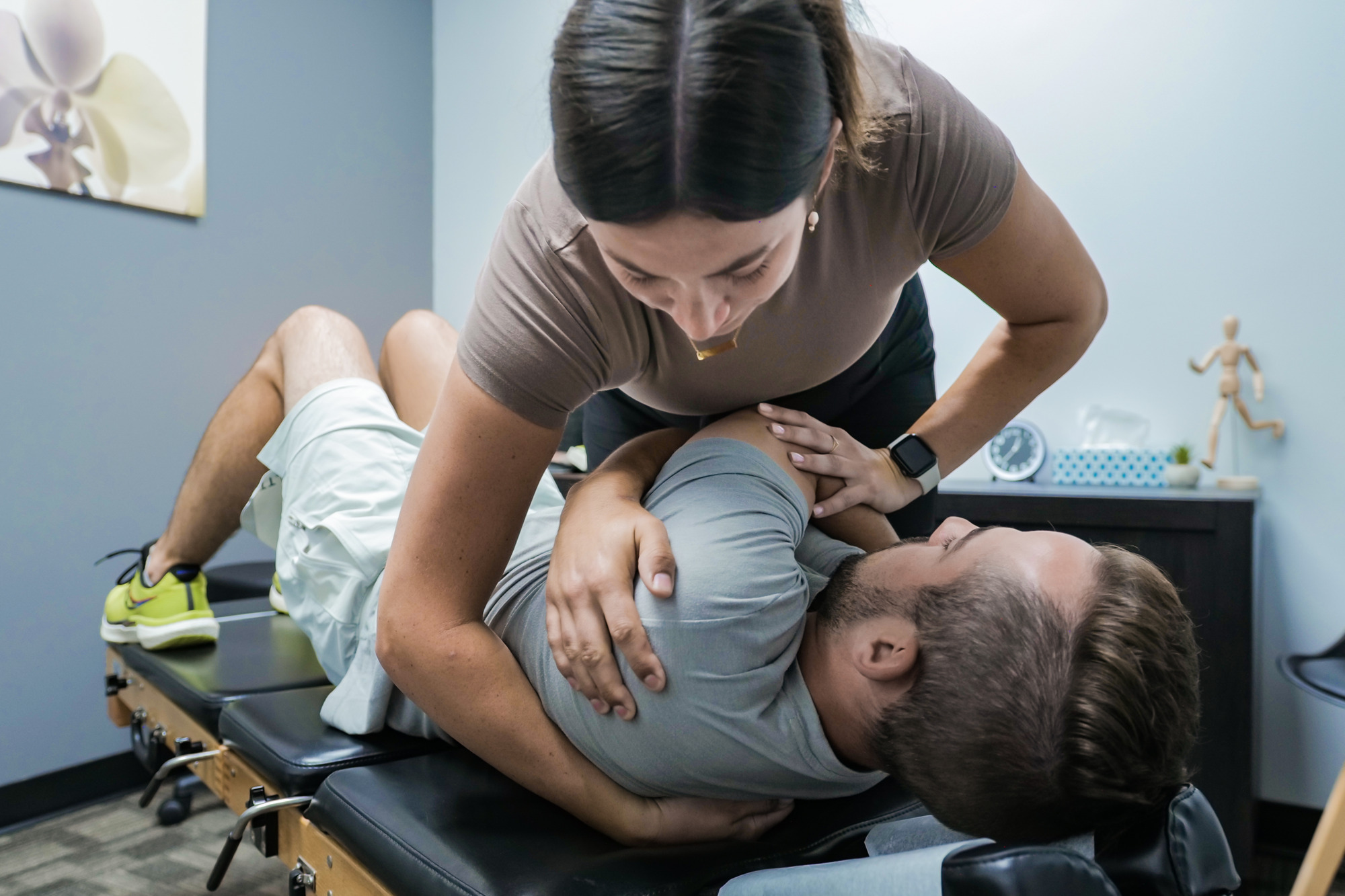
2. Muscle testing as part of the physical exam. I assess the strength and recruitment quality of muscles relevant to your complaint and your sport. The test is: can this muscle hold against a controlled force in a specific position, with the right timing and quality of activation? I’m not looking for raw strength — I’m looking for inhibition, asymmetry, and recruitment patterns that don’t match what your body should be capable of.
3. Identifying drivers. When I find a muscle that’s inhibited, the next question is “why?” Sometimes the answer is local — a joint restriction, a fascial adhesion, a trigger point in a synergist or antagonist muscle. Sometimes the answer is upstream or downstream — a hip problem creating compensatory patterns at the knee, a thoracic restriction altering shoulder mechanics. AK gives me a real-time framework for testing these hypotheses rather than guessing.
4. Treatment with retest. If I think a joint restriction is driving an inhibition pattern, I’ll address it and retest. If the muscle now activates properly, that’s confirmation. If it doesn’t, I look elsewhere. The test-retest cycle is what separates AK from “I think I know what’s wrong, let me try this and hope for the best.”
5. Homework matched to findings. The exercises and self-care I recommend are based on what the assessment actually showed, not on a generic protocol for your complaint.
What the literature supports — and where it’s mixed
Worth being honest about the evidence picture:
The mechanism of muscle inhibition is well-established. AMI is a real, measurable, neurologically-mediated phenomenon. The literature is clear that joint pathology, inflammation, and altered afferent input can produce profound inhibition of surrounding musculature, and that interventions aimed at restoring normal joint function and afferent input can help reverse it.[1][2]
Spinal manipulation produces measurable changes in muscle activation. A 2018 RCT in elite athletes showed significant increases in maximum voluntary contraction and corticospinal excitability after a single manipulation, persisting 30-60 minutes.[3] A separate study found 44-54% increases in motor evoked potentials following manipulation, suggesting changes happen at the level of cortical drive — exactly the kind of effect AK practitioners describe clinically.[4] When AK assessment leads me to deliver an adjustment and I see immediate facilitation of a previously inhibited muscle, the underlying neuromechanism is supported.
Manual muscle testing reliability is the honest weak link. A 2020 study examining force profiles of testers performing manual muscle tests found significant differences between experienced and beginner testers, and even experienced testers showed inter-tester variability and partial intra-tester reproducibility issues.[5] Older research on traditional manual muscle testing in clinical populations also showed reproducibility problems compared to instrumented testing.[6]
The honest interpretation: MMT is a tester-skill-dependent tool. Done by someone with significant training and standardization, it produces consistent results. Done by someone untrained or inconsistent in their force application, it doesn’t.
This is part of why I’ve invested 400+ hours of additional training beyond the initial ICAK certification — including multiple 100-hour AK course series, clinical pearls work with the late Dr. Wally Schmitt, and instruction with Dr. David Leaf at ICAK international meetings. The certification covers the basics; proficiency comes from deliberate practice, study with senior practitioners, and consistent recalibration. It’s also why MMT is best used as one component of a comprehensive assessment, not the sole basis for diagnostic conclusions.
Where AK earns its keep
The honest version of where this approach pays off:
Identifying neuromuscular inhibition patterns that don’t show up on standard strength testing or imaging
Real-time test-retest assessment to confirm whether an intervention actually worked
Untangling complex compensation patterns where pain in one location is being driven by dysfunction elsewhere
Building an individualized treatment and homework plan based on what your specific body needs, rather than a protocol
Performance work with athletes whose strength on paper doesn’t match how they actually move and generate force in their sport
For anything outside the musculoskeletal scope — bloodwork, imaging, allergy testing, nutritional analysis, or specialist medical care — the right answer is referral to the appropriate professional. I work within my scope.
Why this approach matters for athletes
Most assessment systems for athletes rely on either subjective complaint (“my hamstring feels tight”) or maximum-effort strength testing (“can you push as hard as possible against this”). Both have value, but both miss the layer where most performance-limiting dysfunction actually lives.
The athletes I see most often aren’t catastrophically injured. They’re partially inhibited. The hamstring that’s “tight” is often actually under-recruited. The shoulder that “feels off” has a serratus anterior that’s not firing properly. The knee that “doesn’t track right” has a glute that’s not doing its job.
You can train through these patterns for a long time before they become an injury — but they cost you in performance, and they raise your injury risk over time. AK gives me a way to find them earlier and address them more precisely.
Common questions
What does an AK assessment add to my visit? It adds a structured, testable framework for figuring out what your specific body needs on the day you come in. Muscle testing gives me real-time information that informs which interventions to use, in what order, and whether they actually worked before you walk out the door. The treatment itself — adjustments, soft tissue work, exercise prescription — is similar to what you’d see in any sport-focused chiropractic visit; the assessment is what makes the plan more individualized.
Do I need to “believe in” AK for it to work? No. AK isn’t a faith-based system in how I practice it. The muscle either tests strong or it doesn’t. The intervention either changes the test or it doesn’t. You can be skeptical of the framework and still benefit from it, the same way you can be skeptical of “core stability training” and still benefit from learning to brace properly.
Is this covered by insurance? The chiropractic care itself is. There’s no separate “AK fee” — assessment is part of how I work, not an add-on service.
How long does an AK-informed visit take? About the same as a regular chiropractic appointment. Initial assessments run longer (45-60 minutes) because of the comprehensive movement and muscle screen. Follow-ups are shorter (15-30 minutes) since we’re working from a known baseline.
Do you do AK on non-athletes? Yes. The framework is just as useful for desk workers with chronic pain, post-surgical patients managing residual deficits, or anyone whose body has compensation patterns from old injuries. It’s not athlete-exclusive — that’s just where the gains are most visible.
What does an AK assessment actually feel like? Mostly like a thorough orthopedic exam. I’ll have you in different positions — supine, prone, standing, sometimes mid-movement — and apply controlled force to various muscles while you resist. It’s not painful, it’s not strenuous, and you don’t need to be at maximum effort. The goal is to feel how your body responds, not how hard you can push.
If you want to try it
I’m an ICAK-certified Applied Kinesiology practitioner with 400+ hours of additional AK training beyond the certification, including study with the late Drs. Wally Schmitt and David Leaf. I see athletes, tactical professionals, and active people across both Nobility Chiropractic & Wellness in Smiths Falls and Nobility Performance in Stittsville.
If you’re an athlete dealing with persistent issues that haven’t responded to conventional approaches, or you want a more individualized assessment than a generic protocol-based visit, this is the work.
Pietrosimone B, Lepley AS, Kuenze C, et al. Arthrogenic Muscle Inhibition Following Anterior Cruciate Ligament Injury. J Sport Rehabil. 2022;31(6):694-706. doi.org/10.1123/jsr.2021-0128
Sonnery-Cottet B, Saithna A, Quelard B, et al. Arthrogenic muscle inhibition after ACL reconstruction: a scoping review of the efficacy of interventions. Br J Sports Med. 2019;53(5):289-298. doi.org/10.1136/bjsports-2017-098401
Christiansen TL, Niazi IK, Holt K, et al. The effects of a single session of spinal manipulation on strength and cortical drive in athletes. Eur J Appl Physiol. 2018;118(4):737-749. doi.org/10.1007/s00421-018-3799-x
Haavik H, Niazi IK, Jochumsen M, et al. Impact of Spinal Manipulation on Cortical Drive to Upper and Lower Limb Muscles. Brain Sci. 2017;7(1):2. doi.org/10.3390/brainsci7010002
Bittmann FN, Dech S, Aehle M, Schaefer LV. Manual Muscle Testing—Force Profiles and Their Reproducibility. Diagnostics (Basel). 2020;10(12):996. doi.org/10.3390/diagnostics10120996
Escolar DM, Henricson EK, Mayhew J, et al. Clinical evaluator reliability for quantitative and manual muscle testing measures of strength in children. Muscle Nerve. 2001;24(6):787-93. doi.org/10.1002/mus.1070
The honest answer is “before” most of the time — and the second answer is “it depends, here’s how to decide.”
Most chiropractic content on this question hedges. “Either is fine, talk to your chiropractor!” That’s not wrong, but it’s not useful. If you train hard and you’re scheduling care around real performance, the evidence and clinical reality both lean in a clear direction.
This post takes a position, walks through the research, and tells you when the position flips.
A note before we get into it: this is general guidance based on published research and what I see clinically. It’s not specific medical advice for you. I haven’t assessed your body, your training, or your history — and the right answer for any individual depends on all three. If you want a recommendation tailored to you, that’s a conversation we have in person, not on the internet.
The default: adjust before you train
For most healthy, regularly-training athletes, scheduling a chiropractic adjustment before your workout is the better-supported choice.
Two reasons:
1. Better mechanics going into the session. Adjustments improve range of motion, joint mobility, and movement quality. Going into a training session with restored mobility is a better starting position than going in restricted and hoping to “warm out of it.”
2. Increased neuromuscular activation post-adjustment. This is the part most chiropractic content underplays — and it’s the part that genuinely matters for performance. There’s a growing body of research showing that spinal manipulation produces measurable, immediate changes in how the nervous system drives muscle contraction:
A 2018 randomized controlled trial in elite Taekwondo athletes found that a single session of spinal manipulation produced a significant increase in maximum voluntary contraction (MVC) force in the plantar flexors, alongside increased corticospinal excitability. The MVC effect lasted 30 minutes; the cortical excitability effect persisted for at least 60 minutes.[1]
A 2016 study using transcranial magnetic stimulation found a 54.5% increase in maximum motor evoked potential in the upper limb and 44.6% in the lower limb following spinal manipulation, suggesting the effect is driven by descending cortical drive rather than spinal cord-level changes.[2]
A 2018 study showed shortened cortical silent periods and increased motor unit excitability following spinal manipulation, providing further evidence that the changes happen at the level of the brain’s motor control, not just at the joint.[3]
A 2021 motor unit study found altered recruitment patterns following manipulation — specifically, increased recruitment of lower-threshold motor units, suggesting more efficient force production at submaximal loads.[4]
Translation: in the hour or so after an adjustment, your nervous system is driving your muscles more effectively. For most people, that’s a window worth training in — better activation patterns, better mechanics, lower likelihood of compensating into an injury.
It’s also why you’ll occasionally feel surprisingly sharp at the gym after an adjustment. That’s not in your head.
The honest caveat: the research is mixed
A 2019 systematic review of 20 low-bias studies on spinal manipulation and performance outcomes in healthy adults concluded that the overall evidence for performance enhancement is inconsistent, with most studies showing only immediate effects and uncertain clinical importance.[5]
That’s worth knowing. The neuromuscular activation findings are real and reproducible, but whether they translate to meaningfully better squat numbers, sprint times, or sport performance is a harder question. Some studies show effects, some don’t, and the effect sizes vary.
The honest synthesis: if you’re chasing a 1% performance edge in elite sport, this isn’t a guaranteed lever. If you’re a recreational or competitive athlete training regularly and want to get into your sessions feeling well-organized, well-activated, and moving cleanly — the literature plus clinical experience both support adjusting before the session.
It’s a meaningful tool, used in context. It’s not magic.
When the answer flips: adjust after, or skip the session
There are specific situations where adjusting after a workout — or scheduling the adjustment for a non-training day — makes more clinical sense.
1. First-time visits, or a complaint we haven’t worked on before. If we don’t yet know how your body responds to an adjustment in a particular region, scheduling it post-workout (or on a rest day) is the safer call. The first few sessions tell us how reactive your tissues are. Once we have that information, the standard pre-workout pattern usually applies.
2. Pre-competition, especially with a new approach. Competition day is the worst possible time to find out you’re one of the rare people who feels achy for 12-24 hours after an adjustment. If we’re trying something new before a race, match, or event — wait until after.
3. Acute injuries or active flares. If you’re in the middle of an acute flare-up, dealing with a fresh injury, or your tissues are visibly inflamed, adjusting before training is asking for trouble. Manage the flare first; train later.
4. Patients who reliably get short-term soreness post-adjustment. This is uncommon — somewhere in the 10-15% range of people I see — but it’s real. If your body consistently gets a bit sore in the first 12-24 hours after an adjustment, schedule your adjustments for after training or on rest days.
5. When the goal of the visit is recovery, not performance. If you’re coming in specifically because you’re sore, beat up, or post-event — that visit is a recovery visit. Recovery visits work fine post-workout, and often that’s the more sensible scheduling.
A practical note: most of the cases above need an actual assessment, not a guess from a blog post. If you’re dealing with an acute injury, an active flare, or you’re not sure whether the soreness you’re feeling is normal post-training fatigue or something more — book in. Don’t try to figure it out from a website.
Practical scheduling for athletes
Strength session today, adjustment in the morning? Good. Train in the activation window.
Sport practice tonight, adjustment at lunch? Good. Same logic.
Big game / race / event in two days? Adjust today, not tomorrow. You want a buffer if your body has any reactivity, plus the neuromuscular effects are largely settled within 24 hours anyway.
Big game / race / event tomorrow morning? Skip the adjustment unless we have a long history of pre-competition adjustments going well for you. Don’t introduce variables right before competition.
Just played / lifted / raced and you’re sore? Recovery visit. After is fine.
Acute injury or flare? Get assessed first. Don’t book a regular adjustment until we know what’s going on.
How we approach adjustment timing at Nobility Chiropractic
The default at our clinic is pre-workout adjustment for athletes and active individuals — informed by both the neuromuscular literature and clinical experience watching what works.
But “default” doesn’t mean “always.” Every patient is different. Some people are unusually reactive; some have specific injuries or flares we’re working around; some have competition schedules that shape when adjustments make sense. We work that out in your visits.
If you’re not sure what makes sense for your training, mention it during your first appointment. We’ll talk through your schedule, your goals, and how your body has historically responded to manual care, and we’ll build a plan around that.
How long after an adjustment should I wait before training? For most people: not long. The activation effects begin almost immediately and persist for roughly an hour, which is exactly the window you want to be training in. If you’ve had a particularly intensive session — a lot of mobilization, a new region addressed, a manual technique you’re not used to — give yourself 30-60 minutes before max-intensity work.
Will an adjustment make me weaker for my workout? The research consistently shows the opposite — increased force production and motor unit recruitment in the hour following adjustment. The exception is rare individuals who experience post-adjustment soreness; for them, the temporary discomfort can affect performance.
Can I get adjusted on the same day as a competition? Generally we recommend against introducing chiropractic care on competition day unless you have an established history of pre-competition adjustments going smoothly. The downside risk (any unexpected reactivity, soreness, or unfamiliar feeling) outweighs the upside on a day where consistency matters most.
What about Applied Kinesiology specifically? The same logic applies. AK assessments and adjustments produce similar nervous-system effects to standard chiropractic care, and the timing recommendations are the same. (For more on AK specifically, see our post on Applied Kinesiology and athletic performance.)
What if I’m just doing cardio or yoga? Same answer — pre-session is generally better. The activation and mobility effects support quality of movement regardless of training modality.
Does this apply to youth athletes too? Yes, with the same caveats. If we haven’t worked with a youth athlete before, we’ll often schedule the first few visits independent of training so we can establish how their body responds.
Building chiropractic into your training
For athletes who train consistently, regular chiropractic care can be a meaningful part of staying healthy, moving well, and getting more out of the work you’re already putting in. The timing detail above isn’t a hard rule — it’s a starting framework that we adjust based on how your body actually responds.
If you’re an athlete in Smiths Falls, Lanark County, or the surrounding region and you want a sport-focused chiropractor who actually thinks about how care fits into your training, we’d be happy to work with you.
Christiansen TL, Niazi IK, Holt K, et al. The effects of a single session of spinal manipulation on strength and cortical drive in athletes. Eur J Appl Physiol. 2018;118(4):737-749. doi.org/10.1007/s00421-018-3799-x
Haavik H, Niazi IK, Jochumsen M, et al. Impact of Spinal Manipulation on Cortical Drive to Upper and Lower Limb Muscles. Brain Sci. 2017;7(1):2. doi.org/10.3390/brainsci7010002
Haavik H, Niazi IK, Jochumsen M, et al. Chiropractic spinal manipulation alters TMS induced I-wave excitability and shortens the cortical silent period. J Electromyogr Kinesiol. 2018;42:24-35. doi.org/10.1016/j.jelekin.2018.06.010
Robinault L, Holobar A, Crémoux S, et al. The Effects of Spinal Manipulation on Motor Unit Behavior. Brain Sci. 2021;11(1):105. doi.org/10.3390/brainsci11010105
Corso M, Mior SA, Batley S, et al. The effects of spinal manipulation on performance-related outcomes in healthy asymptomatic adult population: a systematic review of best evidence. Chiropr Man Therap. 2019;27:25. doi.org/10.1186/s12998-019-0246-y
Do you toss and turn all night, yearning for a good night’s sleep? You’re not alone. In our fast-paced world, achieving quality sleep can feel like a luxury. Fortunately, by incorporating healthy sleep habits into your routine, you can transform your bedroom into a sleep sanctuary and wake up refreshed and energized.
Crafting Your Sleep Haven
The environment you sleep in plays a crucial role in promoting restful slumber. Here are some habits to create a sleep-conducive space:
Temperature Control: Our bodies naturally cool down as we prepare for sleep. Mimic this process by keeping your bedroom between 60 and 67 degrees Fahrenheit (15.5 and 19.5 degrees Celsius). If you tend to get cold feet, wear loose socks to keep them warm without restricting blood flow.
Embrace Darkness: Light disrupts the production of melatonin, the sleep hormone. Invest in blackout curtains to block any stray light from streetlamps or headlights. Weatherstrip your doors to prevent light from seeping through cracks, and remove electronics with indicator lights from your bedroom.
Power Down Before Bed: Electronics emit blue light, which suppresses melatonin production and tricks your brain into thinking it’s daytime. Avoid using electronic devices like smartphones, laptops, and TVs for at least two hours before bedtime.
Develop a Relaxing Routine
Creating a consistent sleep schedule helps regulate your body’s natural sleep-wake cycle, making it easier to fall asleep and wake up refreshed. Here are some habits to establish a relaxing bedtime routine:
Wind Down Gradually: Don’t expect to fall asleep instantly after a busy day. Allow yourself at least 30 minutes to unwind before bedtime. Take a warm bath, read a light book, listen to calming music, or practice gentle stretches. These activities signal to your body that it’s time to wind down and prepare for sleep.
Find Your Sleep Window: Aim to fall asleep consistently between 8:00 pm and midnight. This timeframe aligns with your natural circadian rhythm, promoting deeper and more restorative sleep. Sticking to a consistent sleep schedule, even on weekends, will help regulate your body’s natural sleep-wake cycle.
Ditch the Afternoon Caffeine: Caffeine has a half-life of 5-6 hours, meaning it takes that long for your body to eliminate half the amount you consumed. To avoid sleep disruption, reduce caffeine intake by early afternoon, especially if you’re sensitive to its effects.
Minimize Blue Light Exposure
Blue light, heavily present in electronic devices and some artificial lights, disrupts melatonin production. Here are some habits to minimize blue light exposure:
Dim the Screens: If you must use electronics in the evening, consider using apps like f.lux or Twilight that filter out blue light. These apps adjust the color temperature of your screen to emit a warmer light that has less impact on melatonin production.
Embrace Daylight: Exposure to natural light during the day helps regulate your sleep-wake cycle. Open your curtains in the morning and get some sunlight exposure throughout the day. If natural light isn’t readily available, invest in daylight-mimicking light bulbs.
Consider Red or Orange Light Bulbs: Most bulbs emit blue light, part of the white light spectrum. In the evening, switch to red or orange light bulbs to create a more sleep-conducive environment. Budget-friendly options include orange party bulbs, while smart light systems like Philips Hue offer greater control over light color and intensity.
Relaxation Techniques for a Calmer Mind
A calm mind promotes better sleep. Here are some habits to quiet your mind before bed:
Take a Warm Bath: A hot bath 90-120 minutes before bed can help you relax and signal to your body that it’s time to wind down. Consider adding magnesium flakes or salts to your bath for an extra dose of relaxation. Magnesium deficiency is common and can contribute to sleep problems.
Quiet Your Mind: Before bed, try reading a light book, meditating, or practicing simple breathing exercises. Avoid activities that require focus or screen time, as this can stimulate your brain and make it harder to fall asleep.
Additional Tips:
Regular Exercise: Regular physical activity can improve sleep quality. However, avoid strenuous workouts close to bedtime, as they can be stimulating. Aim for exercise at least a few hours before bed.
Create a Sleep-Friendly Diet: Avoid heavy meals, sugary foods, and alcohol close to bedtime, as they can disrupt sleep. Opt for a light, healthy dinner a few hours before bed.
See a Chiropractor (Optional): If pain is keeping you awake, a chiropractor may be able to help. Studies show that chiropractic adjustments can improve sleep quality for some individuals.
Ready to start developing Habits for Healthy Sleep?
By incorporating these habits into your routine, you can cultivate a sleep-supportive environment and develop a healthy sleep schedule. Remember, consistency is key!
The more you prioritize these practices, the easier it will become to drift off to sleep peacefully and wake up feeling refreshed and ready to take on the day.